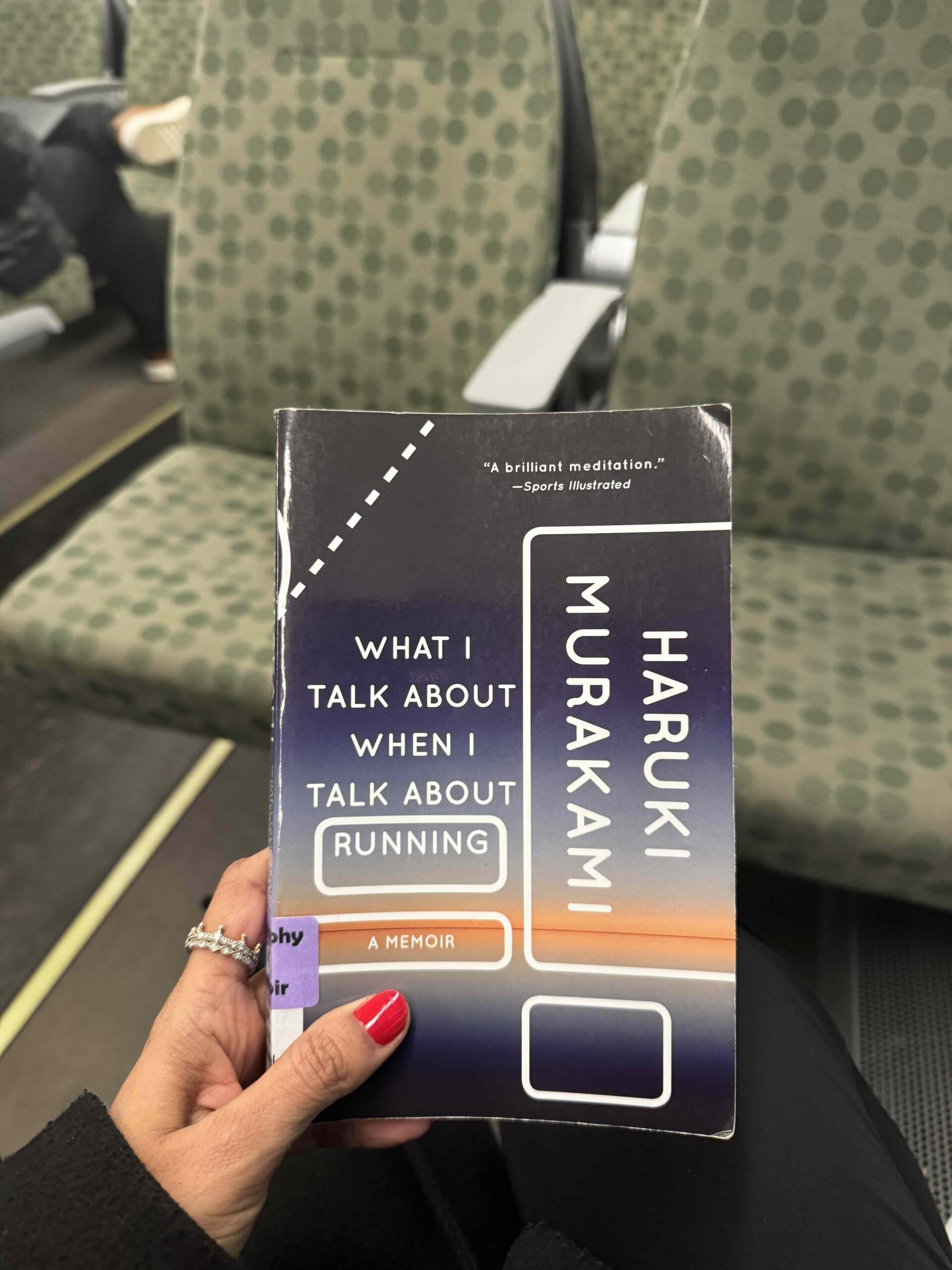
My fav quote from “What I talk about when I talk about running”

I recently read “What I talk about when I talk about running” by Haruki Murakami. If you are runner, I’m sure you’ve stumbled upon this as a book to add to your TBR. I found it beautiful! Haruki Murakami’s stoic sharing of running as an act of meditation, resiliency and goal setting completely resonated with me. And because he took those themes and applied them to being an artist (him being a writer) was the icing on the cake for me.

The book is a very easy read and can be easily finished in a day. For me, books really come alive when they have ah-ha moments – really good quotable parts of the text that make me stop and write down what I read. Here are a few of those moments (and moments of me running as well!)

Commute & Read (Library Books as much as possible)

The most important thing we learn at school is the fact that the most important things can’t be learned at school.

I’m the kind of person who likes to be by himself. To put a finer point on it, I’m the type of person who doesn’t find it painful to be alone. I find spending an hour or two every day running alone, not speaking to anyone, as well as four or five hours alone at my desk, to be neither difficult nor boring. I’ve had this tendency ever since I was young, when, given a choice, I much preferred reading books on my own or concentrating on listening to music over being with someone else. I could always think of things to do by myself.

Say you’re running and you think, ‘Man, this hurts, I can’t take it anymore. The ‘hurt’ part is an unavoidable reality, but whether or not you can stand anymore is up to the runner himself.

People sometimes sneer at those who run every day, claiming they’ll go to any length to live longer. But I don’t think that’s the reason most people run. Most runners run not because they want to live longer, but because they want to live life to the fullest. If you’re going to while away the years, it’s far better to live them with clear goals and fully alive than in a fog, and I believe running helps you do that. Exerting yourself to the fullest within your individual limits: that’s the essence of running, and a metaphor for life.

Sometimes taking time is actually a shortcut.

Being active every day makes it easier to hear that inner voice.

I just run. I run in void. Or maybe I should put it the other way: I run in order to acquire a void

Book Review: Station Eleven

I first heart about this book in 2018 or 2019, but I don’t think I was ready for it back then.

Firstly I was re-finding my footing as an artist. I was definitely more into sci-fi tech than dystopian. And I was also much younger (…with age comes wisdom!)

But this book is spectacular. And the themes of this book (namely: pandemic and dismantling of society) are right on point of the 2020-2022 years.

TLYBlog_BookReview_StationEleven

This book (for me) was a beautiful intertwining of some important ideas in my life right now: art, family, human interaction, humanity and even how the brain works.

Station Eleven by Emily St. John Mandel is a hauntingly poetic view of humanity’s resilience in the face of collapse. The novel captures the lives of several characters before and after the world as we know it ends. At its heart, the story is a meditation on what it means to survive—not just physically, but emotionally and culturally. Station Eleven is focused on the power of art and the fragility of life and socio-economic norms while urging us to reflect on what truly matters.

As always (and because I’m a girl who loves a good quote) sharing some of the quotes that I dogeared in the paperback:

  • and these collection of petty jealousies, neuroses, undiagnosed PTSD cases, and simmering resentments lived together, travelled together, performed together 365 days of the year. But what made it bearable were the friendships, of course, the camaraderie and the music and the Shakespeare, the moments of transcendent beauty and joy when it didn’t matter who’d used the last of the rosing in their bow or anyone slept with.
  • There had always been a massive delicate infrastructure of people, all of them working unnoticed around us, and when people stopped going to work, the entire operation ground to a halt. No more trains running under the surface of cities on the dazzling power of the electric third rail. No more cities. No more films, except rarely, except witlessly, except for the handful of people who happened to have a generator and a collection of DVDs. No more flight. No more towns glimpsed from the sky through airplane windows, points of glimmering light. No more internet. No more social media, no more scrolling through litanies of dreams and nervous hopes and photographs of lunches, cries for help and expressions of contentment and relationship-status updates with heart icons whole or broken, plans to meet up later. No more reading and commenting on the lives of others, and in so doing, feeling slightly less alone in the room. No more avatars.
  • What was lost in the collapse: almost everything, almost everyone but there is still such beauty.
  • “What do you plan to do with it once it’s done?” “Surely you’ll try to publish it?” [the beautiful response] “it’s the work itself that is important to me” [in agreement] “I think that is so great, its like the point is that exists in the world” [in retaliation] “what’s the point of doing all that work” [in response] “It makes me happy, it’s peaceful, spending hours working on it. It doesnt really matter to me if anyone sees it”
  • What do you live for? Truth and beauty.
  • Hell is the absence of people you long for
  • He getting trapped by iPhone zombies. People half his age, who wandered in a dream with their eyes fixed on their screen. He jostled into them on purpose.
  • You probably encounter people like him all the time – high functioning sleepwalkers. …People like him think work is supposed to drudgery punctuated by very occasional moments of happienss, but when I say happiness I mostly mean distractions. …He realized now that he too had bee half-sleep throught hte motions of his life, not specifically unhappy but when was the last time he found joy in his work. He wish he could go back to the iphone people he had jostled and appolgoize to them. I’m as minimally present in this world as you are.
  • FIrst we want to be seen, but once we’re seen that’s not enough anymore. After that, we want to be remembered.
  • Why did we always say we were going to shoot emails? I used to write THX, would it have taken too much time and effort to punch in an extra three letters and just say thanks!
  • In Shakespeare time, the wonders of technology were still ahead, not behind & far less had been lost.

Think Again by Adam Grant (my favourite ideas from the book)

I recently read Think Again by Adam Grant, and I annotated a lot. Here are the annotations. Hopefully they spark some interest in you to think again (or at least read the book!)

  • When people reflect on what it takes to be mentally fit, the first idea that comes to mind is usually intelligence. The smarter you are, the more complex problems you can solve – the faster you can solve them….yet in a turbulent world, there’s another set of cognitive skills that might matter more: the ability to rethink & unlearn
  • When it comes to our own knowledge and opinions, we often favour feeling right over being rights
  • When we think and talk, we often slip into the mindsets of three different professions: preachers, prosecutors and politicians…We go into preacher mode when our sacred beliefs are in jeopardy: we deliver sermons to protect and promote our ideas. We enter prosecutor when we recognized flaws in other peoples’s reasoning: we marshal arguments to prove them wrong and win our case. We shift into politician mode when we’re seeking to win over an audience: we campaign and lobby for approval of our constituents.
  • In psychology there are at least 2 biases that drive [our thinking]: Confirmation bias – see what we expect to see [and] the other is desirability bias: seeing what we want to see.
  • What set apart great presidents was their intellectual curiosity and openness.
  • Research shows that when people are resistant to change, it helps to reinforce what will stay the same. Visions for change are more compelling when they include visions of continuity. Although our strategy might evolve, our identity will endure.
  • In theory, confidence and competence go hand in hand. In practice, they often diverge.
  • The Dunning-Kruger effect – when we lack competence that we are most likely brimming with over-confidence
  • Advancing from notice to amateur can break the rethinking cycle. As we gain experience, we lose some of our humility.
  • Confidence Sweet Spot = Confident Humility
  • Attachment. That’s what keeps us from recognizing when our opinions are off the mark and rethinking them. To unlock the joy of being wrong, we need to detach.
  • If you want to be a better forecaster today, you need to let go of your commitments of the opinions you held yesterday.
  • Productive disagreement is a lifeskill none of us fully develop. Research shows that how often parents argue has no bearing on their children’s academic, social or emotional development.
  • In good fights are the tension is intellectual not emotional
  • Skilled negotiators: find common ground > ask questions > provide a # of reasons > defend attacks
  • After establishing the drawbacks of her case, she emphasized a few reasons to hire her anyway: But what I do have are skills that can't be taught. I take ownership of projects far beyond my pay grade and what is defined in my scope of responsibilities. I don't wait for people to tell me what do and seek for myself what needs to be done. I invest myself deeply in my projects and it shows in everything I do, from my projects at work to the projects I do in my own time. I'm entrepreneurial. I get things done. I love breaking new ground and starting with a blank slate.
  • As a general rule: its those with greater power that need to do more of the rethinking.
  • When we try to convince people to think again, our first instinct is usually to start talking. Yet the most effective way to help others open their minds is often to listen.
  • Inverse Charisma (the magnetic qualities of a great listener): a sense of being listened to with such intensity that you had to be your most honest, sharpest and best self.
  • As consumers of information, we have a role to play. When reading, listening or watching, we can learn to recognize complexity as a signal of credibility. We can favour content and sources that present many sides of an issue, rather than just one or two. When we come across simplifying headlines, we can fight out tendency to accept binaries by asking what additional perspectives are missing between these extremes.
  • In productive conversations, people treat feelings as a rough draft. Like art, emotions are works in progress. As we gain perspective, we revise what we feel.
  • We need to encourage students to question themselves and one another.
  • Lectures are entertaining and informative, the question is whether they are the ideal method of teaching. […] they actually gained more knowledge and skill from active learning sessions (sending students off to find answers instead of the teacher showing the students how to arrive at the answer). It required deeper mental effort, which made it less fun but led to deeper understanding.
  • Perfectionists are more likely than their peers to ace school, they don’t perform any better than their colleagues at work.
  • Respond to confusion with curiosity and interest aka “give time to your confusion”
  • Encourage children to do multiple drafts of the same drawing.
  • Psychological safety is the foundation of a learning culture
  • Best practices in corporate imply that we’ve stopped learning, […] instead we should looking for “better practices”
  • When psychological safety exists without accountability, people operate within their comfort zone.
  • Change the ownership of psychological safety. (ex: if she says that it’s not safe to launch, the team should prove that it is safe to launch)
  • Sometimes the best type of grit, is gritting your teeth and turning around.
  • It’s easy to be a scientist: it’s simply the act of experimenting

Book Review: Upgraded

I’ve been a reading slump for a few months now mainly because I felt like I’ve been reading too many non fiction books.

I usually set a reading goal for myself every year. I definitely aim high. But this year I’m not confident in getting to that goal. I’m about 40% there with only about 20% of the year left. That means I’d have to finish a book every 1.5 weeks. Seems daunting.

I know I could reach that goal reading a whole bunch of fluff that are easy to get through, but for me – reading is a way to knowledge. So even my fiction books have to teach and inspire me in some way.

So, atlas …I persist.

I do want to share this amazing fiction book I recently read. (I borrowed my book from Vaughan Public Library system because I love libraries (and sustainability).
*needs a totebag with that phrase on it*)

Upgrade by Blake Crouch is about a near dystopian future where science has taken on a twisted yet believable turn “DNA editing”. The story weaves between a son (who works for a FBI like agency looking to prevent corrupted gene editing), his sister and his mother (a science genius pushing the boundaries with hopes of saving the earth). There is a lot of scientific jargon (naming of genes etc) with enough depth to help me understand the characters knowledge but also confusing at times (I glossed over that). Blake Crouch is an author that can create drama, intrigue and action to capture the reader’s attention and also help the reader read faster (lol if that makes sense). Since I don’t want to give away any spoilers, I’ll end off here with saying I give this a 5/5 ⭐️

And if you need any further inclination, here are some of the quotes I annotated! Enjoy!

  • We were on the outskirts of the city doing 120mph. The dual electric motors were almost silent.
  • Parts of New York City and most of Miami were underwater, and an island of plastic the size of Iceland was floating in the Indian Ocean.
  • But it wasn’t just humans who’d been affected. There were no more northern white rhinos or South China tigers. The red wolves were gone, along with countless other species.  There were no more glaciers in Glacier National Park.
  • We had gotten so much right. And too much wrong. The future was here, and it was a fucking mess.
  • I had extraordinary dreams and an ordinary mind.
  • I wanted to actually do something, you know? It’s the difference between designing a house and building the thing.
  • Memories were coming back to me, and not just of every book I’d ever read. Random moments of insignificance. Pivotal events that had shaped my life. From a month ago. From a decade ago. From my childhood. It was an eerie sensation. As if someone were brooming out the dark corners of my mind. Wiping off the cobwebs. Repairing frayed connections.
  • “So you’re saying people are too stupid?” “Not just that,” Miriam said. “It’s denial. Selfishness. Magical thinking. We are not rational beings. We seek comfort rather than a clear-eyed stare into reality. We consume and preen and convince ourselves that if we keep our heads in the sand, the monsters will just go away. Simply put, we refuse to help ourselves as a species. We refuse to do what must be done. Every danger we face links ultimately back to this failing.”
  • I’d felt it that night and I felt it on this one-being with Kara quenched some evolutionary thirst. A primal, genetic need to belong to a tribe.
  • We were a bunch of primates who had gotten together and, against all odds, built a wondrous civilization. But paradoxically-tragically-our creation’s complexity had now far outstripped our brains’ ability to manage it.
  • While I waited for my food, I pulled out a small, leather-bound journal I always carried with me, flipped to the next blank page, and started a new letter.
  • You’re working off a flawed assumption. Higher intelligence doesn’t make you less greedy or self-centered or evil. It doesn’t necessarily make you a good person.
  • Right and wrong are constructs born of human sentiment.
  • Nothing but stories we’ve made up and assigned meaning to. They don’t correspond to any objective reality. The only thing real is survival.
  • Maybe compassion and empathy are just squishy emotions. Illusions created by our mirror neuons. But does it really matter where they come from? They make us human. They might even be what make us worth saving.
  • And I was struck, again, as an outside observer, by how much the members of our species needed one another. All these people out in the cold rain. To laugh and drink. To talk about nothing. It was almost as if that need for connection and touch was our … their … lifeblood.
  • “Consider this. For a time, Kara and I were the only upgraded humans on this planet. And what did we do? Immediately tried to kill each other over differences in belief. You got the upgrade and decided to help Kara release a virus that will lead to mass suffering and death. Doesn’t feel like intelligence itself is the answer. It terrifies me to think of a world where we have all the same problems, a billion less friends, and everyone thinks they’re smart enough to be infallible.”
  • “So you’d rather have no world at all?” “That’s a false binary. We are in trouble, but that doesn’t mean this is the only solution. Rejecting something that involves killing a billion people isn’t the same thing as sticking my head in the sand while the world burns.”
  • “You can’t kill humanity to save humanity. Human beings are not a means to an end.”
  • The temptation to swim over was strong. Barter for break-fast. See about getting a boat. But the commotion at 140 Broadway last night must’ve sounded like Armageddon. Anyone in the vicinity would have heard it, and me stumbling into their midst would only raise an alarm. So I settled for watching them from a distance-this forgotten fragment of humanity making a life together in the most inhospitable of places.
  • They seemed truly happy, and it made me happy to watch them—a thousand small kindnesses among people who had nothing to give.
  • We were a monstrous, thoughtful, selfish, sensitive, fearful, ambitious, loving, hateful, hopeful species. We contained within us the potential for great evil, but also for great good. And we were capable of so much more than this.

Book Review: The School of Good Mothers

I can’t recall if it was “tiktok that made me read it” or maybe one of the book influencers I follow on Social – but I recently read the book The School of Good Mothers by Jessamine Chan.

I want to start by saying that I had high expectations for this book.  The book had me hooked at the beginning as we begin to learn about Frida’s (the protagonist mom) very bad day.  Reading this part made me think of the countless times similar ideas pop into a mothers head – but daring to do it…is another question!

The novel continues by illustrating that the state has put into place a “school that will focus on re-programming bad mothers” with the help of robot dolls as the mother’s adopted children no less!  The story is written in away that you are transported to this prison-school where you feel you are sitting in the classroom with the robot dolls.  Majority of the lessons are harsh and challenging.  Mothers are taught to mother in a very mechanical way (read: if this else that).  Consequences are delivered out hourly.  The mothers also learn that there is a school for dads, where in contrast, the dad’s are treated with grace and respect.

The women are graded and medically analyzed to see if they are fit to return to the society as mothers to their children.  Most are not, which drives Frida to take a drastic decision.

This book was interesting right until the end.  I mean I could understand her mindset and her reasons for doing what she did – but I didn’t agree with it. And as always I wanted more science fiction in the story.  Would recommend 6.5/10